Monday, 22 June 2009

Russian Judo Comeback


Russia has always had strong judo traditions. Ever since Vasiliy Oshepkov, the grandfather of Russia Judo came over from Japan in 1914 having studied the art at the famous Kodokan school, the sport has been growing and entrenching in the ex-Soviet Union countries including Russia.


(Vasiliy Oshepkov pictured below)


Oshepkov was only the fourth foreigner and the first Russian to attain the degree of "Shodan" in Kodokan Judo at the time. Formidable in his physique, Oshepkov was nickname the "Russian bear" by the Japanese for his strong build. Mr. Oshepkov is said to have weighed approximately 220lb (100kg) at the time.


Oshepkov was also one of the founders of the Russian sport and self-defence system called Sambo which replaced judo during the 1930s when Judo became highly politicized by the Soviet government. Sadly, Vasiliy Oshepkov himself was accused of espionage and executed in 1937.


The students that Vasiliy taught together with other practitioners across USSR continued to practice the art however and by 1964, very soon after Judo became an Olympic sport, the Soviet Union took four bronze medals at the Tokyo Games.

This success was to continue until the fall of the Sovit Union with many famous Judokas taking medals in every tournament including the Olympic games but since then success has very much eluded Russia. Despite Russian judo players being ranked among the top in their weight classes, Russia could not gain a single medal in the Beijing Olympic games.

Today, a lot is being done to revive the Judo traditions. A new coach, Ezio Gamba has been hired to take the Judo world by storm, the man who took Olympic Gold back in Moscow in 1980 from Neil Adams in the final.

There are high hopes for 2012 London Games, support from the country's great Judo fan Vladimir Putin and I think after five golds at the recent European Championships, Russia will one day impress the world in this sport as it has done in wrestling in the past.

Russia is a country with great potential in both Judo and Sambo and the popularity of both sports is increasing with the emergence of mixed martial arts. Fedor Emelianenko is one man that has made an enormous contribution in this area and now many are choosing combat sambo as a result.

Judo in particular grew due to the character of Kano himself and his work to make Judo a mainstream sport. In this task he succeeded thanks to his ability to lobby for the sport in high echelons of the government and I think Judo has a chance to make a comeback in Russia as the same is happening in Russia.


Sunday, 21 June 2009

Fedor and MMA in Russia

Fedor Emelianenko, one of the best judo and sambo fighters turned to MMA for the money in 2000. He shocked the world and today has an incredible record 30-1 with only one technical loss due to a cut.

Despite being known around the world with more videos on youtube than perhaps of any other mma fighter, he unfortunately remains an unknown in his native Russia, except perhaps for his native town in Stary Oskol. In a country where the Ukrainian boxers (the Klitchko brothers) are known by nearly every granny in the country, Fedor remains unknown to almost everyone except the dedicated MMA fans.

Fedor Emelianenko is one of the very few Russian's that have become highly successful in MMA on the world stage. The only other native Russian fighter that in the past held a big MMA title was the UFC champion Oleg Taktarov. Observing the current world mma rankings, the only fighter from Russia in the top-10 is Fedor.

Russia is known for being a country with good sports schools and many exceptional athletes. One example is Alexander Karelin, an incredible Greco-Roman wrestler widely considered the best ever in the sport. Many of the combat sports receive very little media attention. Tennis, soccer, biathlon, ice hockey are very popular. Judo, Sambo and MMA receive very little media attention. Only recently has Boets TV (Fight TV) channel has been launched dedicated to the sport of martial arts.

Despite Vladimir Putin's Judo interests and even personal support for Fedor, the sport remains misunderstood. Media do not provide any air time and today MMA fans are doing a petition to have the Josh Barnett vs Fedor Emelianenko fight aired. It is unbelievable that in a country where most channels are controlled by the state, Fedor's performance is not aired due to expected low ratings. The man promotes Sambo around the world with his invincibility in the ring and such a small gesture cannot be made.

For all Fedor fans out there and Russian MMA, I am writing to say that Fedor, your are one of the greatest heroes in Russia ever and you have all of our support!! Keep it up!

Friday, 19 June 2009

Hot Summer 2009 MMA Fights to Watch

UFC: Brock Lesnar v Frank Mir, Las Vegas, July 11

There is so much discussion about this on the Internet and so many videos on youtube now. Brock Lesnar is over-hyped, few matches, mediocre record and really he is not even that big. When you look more closely he is not that much bigger than the likes of Josh Barnett and at the same time he is miles behind them in both grappling and boxing technique. His only chance is really using his power, wrestling and applying his ground and pound. And he really has so much power! it is incredible. Visually he looks good at times especially dominating the Frank Mir fight the last time they met.

Frank Mir is actually a strong grappler, a bjj black belt and certainly I think that this is where he should focus. He knows Lesnar's game plan, avoiding exchange of power and looking for openings to submit him. Lesnar has shown that he has the speed and the KO power. His tactic to me seems to get a dominating victory early by KO whether standing or by ground and pound, but if Mir can control Lesnar in the first two or three minutes and take the fight to the ground, this is where he can take advantage of holes in Lesnar's grappling. The knee bar is said to be a relatively easy leg lock to defend (by which Lesnar lost to Mir the last time they fought). It is therefore unknown whether Lesnar has improved at least his submission defense

And Mir is no small guy himself. Both have the same weight (at 265lb) and Lesnar is only 1 cm taller. Practically the same size. Brock just looks like some sort of monster for his size although small compared to real giants like Choi Hong-man weighing in at 330lb and standing tall 7ft 2in (2.18m). No doubt everyone would be interested to see that fight that I hear nearly happened.

Mir says that he is also improving his standup skills. So far it seems to me that Brock prefers not to push for stand-up fighting but he rather work the take-down.

My Prediction: Frank Mir by submission or decision.

Affliction: Fedor Emelianenko v Josh Barnett, Anaheim, California, August 1

UFC is a great organization with many strong fighters. In fact UFC alongside Pride made MMA mainstream in many countries. It is the reason many of us are into MMA and why brazilian jiu jitsu is so popular today.

I have recently been watching over and over Barnett's fights. He looks strong standing but very careful. His last fight with Pedro Rizzo is a good example of this. At the same time as we all know he can be very lethal on the ground, looking very comfortable grappling with the likes of Nogueira who was in fact defending some of those leglocks.

With Fedor I imagine the fight will initially be a standing battle. Fedor I think will be a little more aggressive standing and he really should keep it standing, defending takedown attempts from Barnett. I think strategically for Fedor it would be better to remain standing and once he overcomes Barnett there he should work towards ground and pound. Barnett is probably almost impossible to submit so a standup battle is in his best interests.

For Josh I think his best place is actually on the ground. Working a good takedown and passing the guard. Josh is excellent with leg locks but I think here he should look to secure the cross-mount the same way Mark Hunt did. Controlling Fedor on the ground will be a nightmare too though. Fedor is competing in ADCC this September so I believe his grappling will be world class.

Fedor is my favourite fighter but what I really want is for both fighters to train incredibly hard and put every effort into giving everything for this fight. This fight will go down in history as one of the great fights together with Fedor vs Nogueira and Fedor vs Cro Cop battles. This is the perfect time for their fight. Two great heavyweights at the height of their abilities.

UFC: Anderson Silva v Forrest Griffin, Philadelphia, August 8

Anderson Silva has been named to be the best pound for pound fighter in the world. Nicknamed "The Spider", Anderson's record is 24 victories and 4 defeats holding currently a nine win consecutive winning streak. The current middle heavyweight champion is facing little competition these days and it only seems natural that he moves up to compete against the ex- Light Heavyweight UFC Champion.

Forrest has faced well-rounded fighters in the past like Mauricio Rua but this time he will face a very careful but effective striker in Anderson compared perhaps only to Lyota Machida. Mr. Griffin is looking to change his game away from being a straight brawler. Anderson is an extremely able striker and perhaps the only thing he lacks is real power that many real heavyweights possess. If Forrest can control the fight and work outside Anderson's comfort zone he could stand a good chance. Anderson is tall and normally fights guys that tend to be smaller than him.

This time, Anderson will be facing a very different type of fighter who is able to take a punch and move the fight to the ground using his power to get a win by decision.


UFC: Randy Couture v Antonio Rodrigo Nogueira, Portland, Oregon, August 29

Randy vs Minotauro fight is a legends fight in mixed martial arts. Two great fighters who need no introduction but this time it will be a very different story. The last time Nogueira fought against Mir, this was a very different fighter. He did not possess that incredible stamina and the will to win we saw in the past. He did not seem to be that dangerous submission grappler that he once was, the fighter that other mma fighters would quickly try to stand up against because they knew their skill was no match for the Minotauro on the ground.

Minotauro seemed worn out and did not give off that incredible energy he had in the past. I don't know whether it was the training, his physical condition or the fight itself. I hope this time it will be the great Minotauro of the past, the great champion of MMA and the man second only to Fedor.

At the same time we have Randy. His physical condition is amazing for his age. He is almost superhuman and his loss was I think partly to his diminishing physical condition. I think he should retire now and certainly after this fight he should no matter what happens. Minotauro by all accounts should win this. In their prime, Minotauro was the superior fighter in my opinion and Randy knew this and this is why he did not wish to fight him in the past. Now however, there is nothing really to lose for Randy. Minotauro needs a convincing win by submission here and I think if he makes the effort and trains as hard as he did in the past he can do it. (mind you Randy is incredibly difficult to submit. He drew with Jacare in a grappling superfight and that is no small feat in itself!)

My prediction is Minotauro wins by decision although truly big Nogueira needs a convincing win if he still does not want to retire. Truly Nogueira is one of my favourite fighters. Fedor respects him very much and he will go down as one of the greatest submission fighters in MMA ever.

I like Randy too though. He is such a nice guy. He is also a very popular fighter despite his record. Great respect to him for fighting this fight and I think he will always be a symbol of what the UFC is and was in the past decade or so.


Thursday, 18 June 2009

shoulder jury

Its been two weeks, two full weeks of not doing any training really. Ok, I did one session a week ago which just made things so much worse.
I was at a competition almost three weeks ago where I really hurt my right shoulder bad enough that I could not even lift my arm up. Both of my shoulders felt pretty bad in the past two or three months but after that time I really went and saw a doctor.

The doctors really disappoint me. Many of them contradict each other all the time. I had an x-ray and ultra sound tests done and basically each of the two doctors interpreted the same results differently. I could hardly believe it. One said "you can't train" and the other was like go ahead nothing serious. Basically they don't really know themselves but obviously the shoulders need to heal.

I am thinking of doing some yoga. Swimming is probably out as is rock climbing. Just seems like the only sports activity really left.

As far as treatment is concerned, I got this shoulder injury cream that I apply several times a day and I go to physiotherapy. Not sure if any of this works of course but you gotta try. Probably I might invest some more money and see a sports injury doctor.

I also have these shoulder supports. Wear them during the day but again it is so difficult to see whether they actually help. I heard it is worthwhile wearing one in training as well.

The other thing I also learnt is that you can also help prevent shoulder injury with special creams. I got this one called Bengay cream (here is the website: www.bengay.com) I apply it before training and basically it warms up the muscles helping to reduce the risk of further injury.

Wednesday, 17 June 2009

Roy Dean Blue Belt Requirements DVD Review

Guys,

I got this DVD a few months back and here are my few comments on it.

- Good quality picture etc no complaints here. A well-produced instructional

- It is ONLY for beginners in jiu jitsu. You don't want to get this one if you've being learning jiu jitsu for more than a year and I cannot stress this enough. The range of techniques is very basic. You will review your fundamentals but if you want to see some new stuff to try out in class, get another DVD.

- Gradings. Roy Dean talks a lot about gradings. Personally I don't really believe in this kind of thing. It is nice to see good technique but I think it is sparring and competition performance that counts. You don't need to know hundreds of techniques in my opinion.

- Limited content. This is a two DVD set, but what you get I though was very limited compared to other double DVD sets that I got. You really only get a few techniques here shown in good detail. What you do not get here is a guard series where the blackbelt demonstrates a series of techniques that interconnect.

Overall I give this DVD a 5.5 out of 10 but I was a little disappointed. An ok DVD for beginners but if you want to develop, I recommend you look elsewhere.


Gracie Jiu Jitsu

When the days of the Samurai came to an end, the gun replaced the sword, and new sportive ways to practice martial arts were developed. Eventually, in Japan many different variations of Jiu-Jitsu took shape, including Karate, Aikido, and Judo. But these arts were missing essential pieces of what the complete art of Jiu-Jitsu originally held.

This lack of reality created years of confusion in the martial arts community, a confusion that legendary Bruce Lee would later refer to as the 'classical mess'. Bruce Lee was actually a student of Judo and did many studies on grappling while he was alive. He criticized traditional martial arts as being ineffective. The more traditional combat schools were simply practicing techniques no longer suitable for modern day combat, and with no way to safely test them, practicing these arts became like swimming without water.

It wasn't until the sport art of Judo and the combat art of Jiu-Jitsu were introduced to the Gracie family in Brazil that the real art of Jiu-Jitsu would be brought to life again. Japanese Jiu-Jitsu (practiced as Judo) was introduced to the Gracie family in Brazil around 1914 by Esai Maeda, who was also known as Conde Koma. Maeda was a champion of Jiu-Jitsu and a direct student of Kano, at the Kodokan in Japan. He was born in 1878, and became a student of Judo (Kano’s Jiu-Jitsu) in 1897.

In 1914, Maeda was given the opportunity to travel to Brazil as part of a large Japanese immigration colony. In Brazil, in the northern state of Para, he befriended Gastão Gracie, an influential businessman, who helped Maeda get established. To show his gratitude, Maeda offered to teach traditional Japanese Jiu-Jitsu to Gastão's oldest son, Carlos Gracie. Carlos learned for a few years and eventually passed his knowledge to his brothers.

Helio Gracie, the youngest son of Gastão and Cesalina Gracie's eight children (three were girls), was always a very physically frail child. He would run up a flight of stairs and have fainting spells, and no one could figure out why.

At age fourteen, he moved in with his older brothers who lived and taught Jiu-Jitsu in a house in Botafogo, a borough of Rio de Janeiro. Following doctor’s recommendations, Helio would spend the next few years limited to only watching his brothers teach.

One day, when Helio was 16 years old, a student showed up for class when Carlos was not around. Helio, who had memorized all the techniques from watching his brothers teach, offered to start the class. When the class was over, Carlos showed up and apologized for his delay. The student answered, "No problem. I enjoyed the class with Helio very much and, if you don't mind, I'd like to continue learning from him." Carlos agreed, and Helio became an instructor.

Helio soon realized that due to his frail physique, most of the techniques he had learned from watching Carlos teach were particularly difficult for him to execute. Eager to make the techniques work for him, he began modifying them to accommodate his weak body. Emphasizing the use of leverage and timing over strength and speed, Helio modified virtually all of the techniques and, through trial and error, created Gracie/Brazilian Jiu-Jitsu.

In order to prove the effectiveness of his new system, Helio openly challenged all the reputable martial artists in Brazil. He fought 18 times, including matches against onetime world heavyweight wrestling champion, Wladek Zbyszko and the #2-ranked Judoka in the world at the time, Kato, whom Helio choked unconscious in six minutes. His victory against Kato qualified him to enter the ring with the world champion, Masahiko Kimura, the best Jiu-Jitsu fighter Japan has ever produced, and who outweighed Helio by almost 80 pounds. Kimura won the match but was so impressed with Helio’s techniques that he asked Helio to go teach in Japan claiming the techniques Helio presented during their bout did not exist in Japan. It was the recognition by the world’s best to Helio’s dedication to the refinement of the art.

Since 1925, more than 40 members of the Gracie Family have dedicated their lives to the practice and dissemination of the techniques and philosophy of Gracie Jiu-Jitsu, making it the largest family of athletes in the world.

--------Note: the article above has been taken from Gracie Jiu Jitsu Academy Website-----------


Top Row left to right: Rickson Gracie, Rolls Gracie, Carlos Gracie, Helio Gracie, Robson Gracie, Mauricao Gomes

Bottom Row left to right: Royler Gracie, Carlinhos Gracie, Rolin Gracie, Rorion Gracie, Rolker Gracie, Royce Gracie

I got the photo from facebook and I think it is really a good one. You don't see so many of today's stars so young and together. Jiu Jitsu would probably not be what it is today without them.


Below are some good brazilian jiu jitsu demonstration videos I found on youtube which I really enjoyed.


facebook on jiu jitsu

A quick note on facebook. First, for those that do not use facebook (facebook.com), this is a great tool to stay in touch with fellow jiu jitsu practitioners.

I actually went to a jiu jitsu competition a month ago and realized it then how useful facebook actually is. Firstly, in facebook you have "events", where you can join and see what people are saying about the competition you are attending. Normally the organizers of the tournament will create an event like this anyway.

The other thing is of course when you actually go to the competition itself, talk to other guys and then connect with them afterwards. I myself did not have a camera nor anyone to film me, but many guys do. I go tons of photos and videos of the tournament this way and a few photos of myself included. Facebook is really cool with sharing photos and videos and the more guys you connect to the better. In fact, once you have connected enough jiu jitsu people, soon facebook will recommend you attend new tournaments where your friends are participating. Social networks are excellent at this.

The other thing is of course you can link to groups related to jiu jitsu/judo and become a fan of Gracies and other famous guys. Your club may have a facebook group where many photos from competitions are posted and it is always worthwhile being there just to check from time to time.

If you are an MMA fan, I recommend you become a fan of Inside MMA. The free video interviews you get from these guys are great. (and I think Bas Rutten is such a character:), check the youtube highlight below! )


Lastly, it is all about learning new things. You can ask people their views, post comments and just find out things you didn't know.

Tuesday, 16 June 2009

Marcelo Garcia

I wanted to dedicate this small post to one of the current legends in jiu jitsu, Marcelo Garcia.

Marcelo 'Marcelinho' Garcia is one of the very top jiu jitsu players, competitors and submission grapplers in the world today. Not only this, he is also considered one of the top pound for pound competitors. He has just recently won the Worlds Middleweight Gold but has done well against even the biggest fighters.

Marcelo is nicknamed "The Human Backpack" for his trademark rear naked choke submission from backmount. A black belt under Fabio Gurgel of Alliance, he is one of the most technical fighters today.

Apart from the medalling numerous times in ADCC and BJJ Worlds, just look at his record. Marcelo has defeated stars far heavier than him including Ricco Rodriguez (by tap out), Xande Ribeiro (by rear naked choke), Andre Galvao (several times, including by choke) among many others. (these guys I just know)

Marcelo is known also as an amazing teacher of jiu jitsu and I will certainly look to purchase his instructionals soon and will review them here.

Although so far his success has not translated into the MMA world, Marcelo is certainly one of the greats of today and his name should be known to all.


Marcelo Garcia Highlight


Fight with Roger Gracie

Monday, 15 June 2009

Branches of Jiu Jitsu

Hi everyone,

today's post I would like to dedicate to branches of jiu jitsu. There are many of them but the ones that seem to be highlighted as the most popular are

Gracie Humaita, Gracie Barra, Alliance Jiu-Jitsu, and Carlson Gracie Jiu-Jitsu. All are said to trace back to Hélio Gracie and Mitsuyo Maeda.

There are however others that you keep seeing when you look at medalling competitor backgrounds. They include Brasa, Check Mat, Atos and Nova União among others. Nearly all are connected to their founder (s) and I would like to cover them at least a little bit hear. I don't have all the info, so if anyone has anything to contribute, i am more than happy to post it of course.

-----------------

Gracie Humaita

Gracie Humaita is probably the oldest branch of brazilian jiu jitsu. Founded by Helio Gracie himself, jiu jitsu is taught the way it was taught originally by master Helio. Today, Gracie Humaita is lead by Royler Gracie and Rolker Gracie. This is the old school where many of the famous Gracie's originally trained including Rickson Gracie and Royce Gracie, before they founded their own schools.
The Gracie Humaita team is strongly represented in competition by the Ribeiro brothers (Saulo and Xande), Kron Gracie and remains one of the strongest in the world today.

-----------------

Gracie Barra

The first Gracie Barra School was founded in 1983 by Carlos "Carlinhos" Gracie, Jr. and today has over 400 black belts and 200 academies around the world. This the largest brazilian jiu jitsu association today.

Gracie Barra has one of the strongest jiu jitsu teams including Roger Gracie, Braulio Estima and Romulo Barral. In addition, Gracie Barra has many notable MMA fighters in its ranks including Renzo Gracie and Renato "Babulu" Sobral.

-----------------

Alliance Jiu Jitsu

Alliance Jiu-Jitsu was created in 1991 by two prominent practitioners, Romero "Jacare" Cavalcanti. Some of his first black belts were Fabio Gurgel, Alexandre Paiva and Fernando Gurgel.

Later after Jacare moved to the USA (from Brazil) the team had a split and some of the best guys left founding the Team Master.

Alliance continued with Jacare and Fabio Gurgel and the other 2 original founders after some years the Team is stronger then ever wining 2 World Championshipis back to back in 08 and 09.

Today, many Alliance academies are located in the US and include jiu jitsu stars such as Chris Moriarty, Rubens "Cobrinha" Charles, Sergio Moraes and Marcelo Garcia.

Alliance headquarters are still located in Sao Paulo, Brazil and are run by Fabio Gurgel himself.

Alliance team has won the 2008 and 2009 mundials.

-----------------

Carlsons Gracie Jiu Jitsu

This branch of jiu jitsu was founded by the late Carlson Gracie Sr., the eldest son of Carlos Gracie. After leaving the Gracie academy in the mid-60s, Carlson focused on competitive jiu jitsu which his team was able to dominate for more than 30 years.

Carlson Gracie Jr., the only son of Carlson who trained with his father from the age of 3 and now heads Carlsons.

-----------------

Information is scare but clearly out of the four main branches, Alliance is the youngest. I wish that in the future, we bjj practitioners have the opportunity to learn more about the heritage of jiu jitsu, the main branches and teams, and about the people that created this magnificent art.

brazilian jiu jitsu for girls

Girls in brazilian jiu jitsu and for than matter judo is an interesting topic that keeps coming to my attention. Today I think no one will doubt that this is a male dominated sport for a number of reasons.

Let me see what factors are at play here:

  1. Girls are weaker.
Yes, girls are definitely weaker. Men can normally over-power girls by using there upper body and I remember myself when I started learning judo, doing newaza with a much smaller brown-belt girl. I don't know what I was doing but simply used brute strength until I got tired. She defended and yet could not submit me simply because I just powered my way out of everything. (some girls can be very tough though!!)

Here girls are at a disadvantage but this should not prevent them from learning the art. I can see that it is perhaps demotivating at first, losing over and over again to guys who just can't bare losing and don't want to give the girl even a chance. With time however, those that survive at least the first six months of training find out that it is possible to give a complete beginner boy a hard time.

I just hope girls that do decide to train and are not intimidated by this factor get the best out of being the weaker player. They can focus on becoming technical and of course their flexibility.

Getting fitter though helps. Some clubs have tough training and you need to get fit for it.

     2. Girls are smaller

Yes, girls do tend to be smaller than guys. I don't think this is as relevant as the first point. Yes girls tend to be shorter and lighter than guys, but then I myself have sparred with guys twice the size of me. When I do this, I focus on my technique. I don't even try to muscle them and I only use my strength at the point when I am focusing on my submission.

You are who you are. If the guys is bigger than you, there is nothing you can do to change that. Many big guys have bad cardio, so here you may even have an advantage. This is a universal factor for both sexes.

     3. BJJ and Judo are rough sports

I think this one is a major factor. When guys get bruises or cuts, they feel kind of proud. When girls get them, they are unhappy. If you are a girl, I guess it is just not right to walk around with a black eye.

     4. Its a male dominated sport

BJJ and judo are male dominated sports. Thats just a fact. I don't have any empirical data on this, but I imagine its 1%-3% at the most.
It also depends on the club of course. Guys with tough training and "special" attitude are just not a great place for a girl to spend 5-15 hours a week.
Some girls feel more comfortable going in groups but it is certainly hard to find a friend to come with for this. The girls there if there are any may be far more advanced or you may not get along all that well. I can really see how difficult it may be.

     5. Guys dont like to train with girls

There are some guys that love to train with girls. Others don't like it at all and I think there are more of these. They somehow are threatened by the fact that they might lose. There are also those that just feel uncomfortable touching/holding a woman's body.

I can understand the last one. I don't really mind training with them but sometimes it is a bit uncomfortable. I start thinking what they might be thinking when I grab them a little rough or in a particularly delicate area.

     6. Contact

Some girls feel uncomfortable of making such close physical contact. Getting man-handled for an hour may not appeal to every girl. There are of course positions like the guard where you spread your legs and the guy must push near the groin area to open the guard. This may not be the favourite thing a girl does on a thursday night!


     7. Perception

This is a martial art and a sport. Many girls just prefer to go dancing or yoga. Many just don't want to be a good submission wrestler and they don't want to devote so much time to this pursuit therefore. It not that cool especially for a girl no matter what we brazilian jiu jitsu practitioners think.

The perception is that it is a man's sport just like boxing and therefore it is hard to get into it and stay in it for a long enough time.


---------------

There are so many different things to say on this subject and I look forward to hearing other people's views on the subject.

Wednesday, 10 June 2009

BJJ Resources

The Internet is great and you can find a whole lot of resources available here. I mean blogs, videos, training tips,, everything. I have a little list going here as well but what I would really like to know is what everyone else is reading and what is the most popular.

Of course one area that everyone is searching to find out about is competitions. Most people are searching for local competitions that are taking place and here forums and association websites are the most useful. Since I aim on competing in Europe, I have a few resources that are available to look for competitions here.

One of the best is the European Fight Network. All the top bjj competitions will be available here that are coming up. Really excited about going to the Gracie Invitational in 2010 (in London) and of course the Disneyland Paris Open sounds like a lot of fun.

These I understand are the bigger competitions. There are smaller ones going on though and you can always have a look at the competitions section in the forum of Gracie Barra UK for example. You are likely to find a lot of updates on the upcoming and past competitions.

For larger competitions held more internationally there is the International Brazilian Jiu Jitsu Federation which has a calendar of its own events held throughout the year. For Europe I think there are the European Jiu Jitsu Championships which were held in Jan 2009. So there is something to look out for next year.

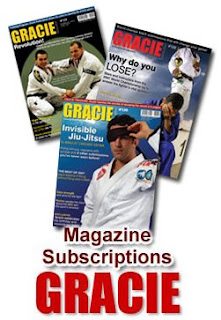
Gracie Magazine


Hi guys. I have subscribed to the Gracie Magazine (Gracie Mag). I am based on Moscow, Russia and got my first 2 issues so far delivered. Absolutely great magazine, I really enjoy it and I recommend it to any one learning jiu jitsu.

This magazine is the authority in the jiu jitsu world. Every issue is great and you really get to know what is happening in the bjj world. You learn about the stars of today and about the legends on the past. It really keeps me going in my training and the contributors are black belts and legends themselves like Kid Peligro. You really get a taste of jiu jitsu and I love it!

I would say the material is less instructional but rather consists more of what is going in the jiu jitsu world today. You have normally some techniques sections but what you really get out of the issue is new academies, bjj artists, competitors, what they say about different topics. I loved the magazine's analysis and opinion polls on who were the greatest players in the 80s and 90s, still available on the Internet. The quality of the material is remarkable. You just dont get it anywhere else.

The magazine was founded in 1996 by Carlos “Carlinhos” Gracie Jr. and Luis Carlos “Luca” de Moraes Atalla. It is the only monthly magazine dedicated solely to coverage of jiu jitsu. The magazine is published in both English and Portuguese.

They also have an online store. I have purchased, admittedly not from them, the 2008 BJJ World Championships Finals video. Definitely getting the 2009 one from them. Its just great to be a fan of the likes of Roger Gracie, Xande and Andre Galvao.

Congratulations to Roger Gracie!!!


Congratulations to Roger Gracie on becoming the 2009 Super Heavyweight and Absolute BJJ World Champion. He is now the two-time jiu jitsu world champion alongside Ronaldo Jacare (2004 and 2005), Xande Ribeiro (2006 and 2008). Roger is now the fighter with the most titles in the world jiu jitsu championships being the six time heavy weight world champion alongside.

To be the absolute world champion is the most prestigious of all titles. He is the strongest gi fighter in the world and his ability to submit his opponents just shows how incredible he is. I read he submitted nine fighters on his way to the title this year with cross lapel and ezekiel chokes. Amazing!

Tuesday, 9 June 2009

UFC Undisputed 2009 Video Game

Got this game the day it came out in the UK. So far really enjoying it. The career mode is probably the most interesting part but havent tried the XBOX Live stuff. (i have an Xbox 360 by the way)

The controls are surprisingly good although grappling I have found considerably more difficult to master compared to the standup game. I am getting there though. They claim to have a whole range of martial arts included in the game including bjj, boxing, muay thai, judo and wrestling. Personally, the Judo throws are the most impossible to implement.

The career mode allows you to train up your fighter adding strength, speed and cardio. At the same time you have the ability to improve skills by sparring. The better you do in the sparring sessions, the better your fighters skills. So far I have found that while at the lower levels I can easily win with just a standup game, when I get to Frank Mir and Minotauro Noguera, I immediately lose by submission or ground and pound. Submissions and ground grappling is clearly a more advanced part of the game. (at least it seems to me)

Of course you really miss some of the top fighters that are outside of the UFC. Of course Fedor. It also seems strange that at the moment Tim Sylvia and Andrei Arlovski are fighting for Affliction instead of the UFC and they are included. Would really be great to have an MMA game that includes all top fighters of today rather than just UFC.

The other thing I thought would be kind of cool for a project like this is to include some cool anomalies that come up in the sport. For example get Hong Man Choi, Zulu, Bob Sapp freaks but also super advanced grapplers like Roger Gracie, Xande Ribeiro, Jacare and Jeff Monson who are fighting in MMA anyway.

Generally great game. A bit much to learn but I guess that also makes it fun since there is a lot to master in the controls. Better than expected! at least 9 out of 10

Sunday, 7 June 2009

BJJ World Championship 2009 RESULTS (BLACK BELT ADULT)


BLACK BELT ADULT

ROOSTER

FIRST bruno malfacine Alliance

SECOND caio terra Brasa

THIRD bernardo pitel Nova União

THIRD felipe costa Brasa

LIGHT FEATHER

FIRST guilherme mendes Atos

THIRD carlos vieira Check Mat Bjj

THIRD daniel beleza academy of combative

FEATHER

FIRST rubens charles Alliance

SECOND bruno frazatto Atos

THIRD rafael mendes Atos

THIRD mario reis Gracie Barra

LIGHT

FIRST michael langhi Alliance

SECOND gilbert burns Atos

THIRD philipe della monica Gracie Barra

THIRD rafael barbosa Soul Fighters

MIDDLE

FIRST marcelo garcia Alliance

SECOND sergio moraes Alliance

THIRD lucas leite Check Mat Bjj

THIRD alan do nascimento Check Mat Bjj

MEDIUM HEAVY

FIRST romulo barral Gracie Barra

SECOND tarsis humphreys Alliance

THIRD otavio de souza Gracie Barra

THIRD victor estima Gracie Barra

HEAVY

FIRST braulio estima Gracie Barra

SECOND alexandre de souza Gracie Florianópolis

THIRD alexandre ceconi Rillion Gracie

THIRD rafael lovato Gracie Humaita

SUPER HEAVY

FIRST roger gracie Gracie Barra

SECOND ricardo gonzalez Nova União

THIRD thiago gaia Nova União

THIRD bernardo faria Alliance

ULTRA HEAVY

FIRST gabriel vella Alliance

SECOND rodrigo cavaca Check Mat Bjj

THIRD marcio corleta Winner

THIRD andre de freitas Cesar Gracie

OPEN CLASS

FIRST roger gracie Gracie Barra

SECOND romulo barral Gracie Barra

THIRD claudio calanzas Atos

THIRD gabriel vella Alliance


Source: International Brazilian Jiu Jitsu Federation

A great well-done to Roger Gracie who was able to submit all of his nine opponents from the point. For a very comprehensive review of the mundials 2009 please take a look at the video below:


Thursday, 4 June 2009

Fedor Emelianenko vs Josh Barnett set to fight on August 1 2009


Ok, this is a little of the subject off grappling but I have to post this just for the sake of saying a few words for Fedor and Josh, two incredible grapplers in MMA today.

Affliction: Trilogy is the third installment of MMA events promoted by Affliction Entertainment. Affliction: Trilogy is to take place on the 1st of August 2009 in Anaheim, California at the Honda Center. (same location where the other events took place)

As in the past, the event will feature some of the biggest names in MMA today and the highlight will be between certainly the top heavyweights in the world today, Josh Barnett and Fedor Emelianenko.


Josh Barnett

This guys is a 114kg monster that is 1.91m tall. A catch-wrestler by background with strong submission skills he has defeated a long-list of MMA legends including Randy Couture and Antônio Rodrigo Nogueira. Holding a record of 24-5-0, 3 of his loses came from Mirko Filipovic Cro Cop. The guy is at his peak right now and is ranked by MMAWeekly.com and MMANews.com as the No. 2 Heavyweight fighter in the world.

Josh Barnett is a very experienced fighter. Having fought in both Japan and in the UFC, he has fought fighters of every style. Having defeated Randy Couture for the UFC Championship belt and been Open Weight King of Pancrase Champion, Josh is a veteran of the sport. We can also see from youtube a video of him wrestling in the ADCC, which just shows how good his grappling really is.


--------

Fedor Emelianenko

Fedor is the #1 ranked heavyweight in the world today and considered by Inside MMA, the greatest of all time. The Russian is a very well-rounded fighter with a strong judo and sambo background. With a record of 30 wins and one loss (by a cut), Fedor is a phenomenon in the MMA world. His most notable fights include wins against Antônio Rodrigo Nogueira and Mirko Filipovic.

-------

There is a lot being said about this great match-up that either way will make history. Both are MMA legends and whatever happens, every remote fan will be glued to the screen on august 1. Both guys I hope will put immense training efforts for this bout and will go down in history as two of the greatest fighters in the sport.

Just one thing I wanted to say about the fighters out there. I think Josh is the best match for Fedor today. Frank Mir is another guy that would be worth seeing in the next fight. The other guys like Lesnar first need to prove themselves. Lets see Lesnar beat Josh Barnett. Josh would dominate Brock and would likely will win by submission in the first or second round.

Thursday, 21 May 2009

Rigan Machado Secrets of the Half Guard Review

Rigan Machado is certainly a specialist expert on the half-guard. I have bought this 3 dvd set and was very much impressed. Before I give a full review of the DVD itself, let me write a little about Rigan himself.

Rigan Machado is a jiu jitsu legend by all accounts. He is an 8th degree black belt in Brazilian Jiu-Jitsu under Carlos Gracie Jr. He is a former Jiu-Jitsu world champion and is considered one of the greatest grapplers of all time with an unbeatable record of eight consecutive years of winning every belt division from ages 14 to 21. He totaled 365 wins with no losses and performed 19 matches in one day with all of them finishing in submission — a record no one has achieved since.

Firstly what I liked about the instructional set is that it clearly explained the fundamentals of the half guard. I have always been fond of the half-guard especially after watching Saulo Ribeiro's Revolution Series but this set has really shown to me how much there is to the half-guard and that this truly is one of the most fundamental positions in jiu jitsu that every player has to know well.

Rigan's demonstrations are fantastic. His explanations are very well presented and each move is very clearly explained. Importantly in my opinion, Rigan shows no only the half-guard postion on the ground but also gives a good grounding on tactics and transitions i.e. how to move from stand up grappling to the half-guard, how to work on the ground from the half guard when you are on your back and the opponent is standing. He also shows some very nice submissions here, how to finish your opponents and this is done with perfection.

For one, I have particularly enjoyed the leg locks in the series. Rigan shows immaculate transitions into leg locks and I will be sure to build these into my game as I develop my jiu jitsu further.

10 out of 10 a must buy DVD set for intermediate and above. It is not the first DVD set you want to buy but if you are looking to further develop your half-guard game, you must get this!

Wednesday, 20 May 2009

Leading Judo Players of Today


There seems to be so few articles on the internet about who are the top judo players of today that I wanted to cover this in my blog. To do this, I went to the International Judo Federation website and took a look at the IJF World Ranking list (as of 14 May 2009)

- 60 kg

Jeroen MOOREN (NED)

- 66 kg

Miklos UNGVARI (HUN)

-73 kg

Volodymyr SOROKA (UKR)

-81 kg

Ivan NIFONTOV (RUS)

-90 kg

Yves Matthieu DAFREVILLE (FRA)

-100 kg

Takamasa ANAI (JPN)

+100 kg

Oscar BRYSON (CUB)

Tuesday, 19 May 2009

Leg Locks, the Basics

A leg lock is a submission technique applied to the joints of an opponents leg. Leg-locks are considered more difficult to apply compared to for example arm-locks particularly on bigger opponents because legs tend to be stronger than arms. Mixed martial artists, submission grapplers, shoot wrestlers, sambo players and brazilian jiu jitsu players practice these techniques. Note that judoka's on the other hand do not practice these. It is worthwhile noting that Sambo has the most developed leg locks in their art and even junior Samboka tend to be very capable in leg locks compared to bjj players in my view.

Leg-locks training and sparring is more likely to result in injury in practice compared to other submissions. Excess force can cause serious injuries such as bone fractures or dislocation with excessive muscle damage. Knee bars and heel hooks applied with excessive force can result in serious knee injuries.

Stephen Kesting in his leg locks DVD calls the leg locks below "High Percentage" leg locks because really these are the leg locks that you are likely to get much more often than some of the other leg techniques available. These four are the highly effective techniques that each grappler needs to focus his attention first for things like competition.


BASIC LEG LOCKS

Straight Ankle Lock

The Straight Ankle Lock also known as the achilles lock is applied by securing one of the opponents legs, placing his foot under the armpit and applying pressure to the achilles tendon with the bony part of the forearm.

Knee Bar


The kneebar (AKA the straight legbar) is a leglock that hyperextends the knee that works very similar to the armbar applying pressure to the opponent kneecap. Leverage is applied by moving hips forward and shoulders backwards thereby hyperextending the knee joint.

Heel Hook


The heel hook is a twisting technique applied to the foot and affecting several joints in the leg causing pain and potentially injury in the ligaments in the knee. Force is applied to the ankle which is then passed through to the knee itself.

Considered a very dangerous technique with a high risk of injury, it tends to be banned in brazilian jiu jitsua and submission grappling at the lower experience level and sometimes entirely.

Toe Hold


The toe-hold is in fact a type of ankle lock. The image demostrates the figure-four hold, a most common type of hold used. Here twisting and extension force is applied to the ankle by grabbing the toes of the opponent.


----

Stephen Kesting says in his leg locks DVD the following idea. Many players focus on leg locks as an alternative when they meet difficulties in passing the guard. He proposes to train hard in both and in the end it will become clear how interconnected they are. Don't substitute your weak guard passing with leg locks.


Monday, 18 May 2009

My Book Review – Brazilian Jiu Jitsu: Theory and Technique (Renzo & Royler Gracie, with Kid Peligro & John Danaher)


First published in 2001 this book was the first Brazilian Jiu Jitsu book published in Russia in 2005 by the publisher Boevoy Sport.

Royler and Renzo Gracie are absolute masters of their art. The book itself however I found has a number of drawbacks despite the very good illustrations. (it is a hard-cover)

This book firstly I think is a first look at brazilian jiu jitsu from a perspective of a beginner. All techniques included in the book are fundemental, however the order in which they are shown is somewhat sporadic, with a huge mix between different types of positions, sport vs. self-defense techniques. All this makes the book at the very least difficult to use as I actually have to flick through the book to actually find the technique that I need.

The techniques themselves are demostrated with photographs of the two Gracies in white gi's. I think in some techniques it is difficult to actually follow the smaller details.

My favourite Gi positional move which I picked up from the book has been the lift from north-south position into the back mount which I have since then been able to succesfully incorporate into my game during sparring.

I recommend this book for white belts in their first year of training. For higher grades I would still recommend something more advanced.

8 out of 10 a great book with quality foundation material, an excellent introduction into the art of brazilian jiu jitsu.

UK Competitions This Year 2009

I've been thinking of competing in some smaller competitions this year. Just wanted to share some of these here with some information I have.

23-24 May - U.M.A. International Open Groundfighting and Grappling Championships ('No Gi') Groundfighting and ('With Gi') Grappling

14 June - North England Grappling Championships

21 June - British Open

28 June - Ground Control 5

5 July - Combat Academy Groundfighting

25 July - 3rd Brighton Open

8 August - Grapplers Showdown Gi Challenge - London Open

??? - Bristol Open Summer Leg 2009 (not confirmed yet)

13 September - U.M.A. Open 'With Gi' Groundfighting Championships

September 2009 - National BJJ Novice Tournament - Gi

14-15 November - Kent Open GI Competition

6 December - U.M.A. Open 'No Gi' Grappling Championships


Yep, so these are the ones that I am considering going to. Going to the first one on the 23-24 May this weekend and will sure let you know how it goes. This is my first competition ever:)

Generally wanted to mention that it is of course sometimes difficult to find suitable competitions. Some don't actually have websites which I think is not acceptable. Others are not really included in lists of competitions for the year because they are small and are not planned in advance. As brazilian jiu jitsu develops and becomes even more popular in the UK and hopefully in Russia, more information will be available in a more organized fashion I believe.

FAQ for beginners for BJJ and Judo

1. When can I start?

You can be of any age, it really does not matter. Of course both of these supports are contact sports and sparring, throws etc can and do lead to injuries. A good warm-up sessions is therefore important to prevent injury.

Most adult groups will have players aged between 18-35 but sometimes older players come. Some will have a background in other related martial arts like wrestling. Also people vary in their build and physical condition. You don't need to be amazingly strong or fit to start bjj. It is only if you wish to reach a high level and compete and it of course takes years to get there. Start small and focus on core techniques.

* - just check out Roger Gracie. He does not use fancy techniques but has amazing detail and submits everyone.

----------------

2. What do I need to start training?

For your first class you would need a gi/kimono available normally in white or blue. (in judo both colours are allowed, bjj practitioners also wear other colours). Also bring a towel and shower gel and flip-flops.

Other accessories you may want to purchase later may be

a) Gum Shield - good to take care of your teeth as minor accidents do happen and dentists are very expensive (and unpleasant!)

b) Head guard - you will see my earlier thread on cauliflower ear. If you don't have it then you probably don't need to worry about it, but if you get it and are concerned, this is the way to go to protect you ears from deformity.

c) Knee pads - very good as it is always good to take care of your knees. Bruises etc may result from falling on your knee (knees) or performing exercises involving knee contact.

d) Rash guards - always a good idea to have. They help prevent staph infection and reduce wear and tear of your gi. Good for both gi and no-gi training.

e) Shorts - you will need these for no-gi training.

f) Other accessories - shoulder support, ankle support. Depending the types of injuries you may have, these may be useful items.

You dont need any of this stuff for your first training session. Just come in track suit bottoms and a t-shirt. You'll find out whether you like it and then you can get a gi.

----------------

3. What does a typical BJJ or Judo Session look like?

A typical sessions can vary but normally is 1-2 hours long and involves:

a) Warm-up: some jogging followed by exercises focused to develop your cardio and strength.

b) Specific exercises: various exercises are used to practice break-falling and ground awareness. These include forward rolls, pulling yourself foward with your arms, etc

c) Instruction and practice: here the intstructor demostrates techniques which are then practiced by the students in pairs without full resistance.

d) Sparring (known as Randori in Judo): involves free grappling with each player exercising full strength to throw, submit or pin (only in Judo) the opponent. Sparring excludes striking, grabbing fingers or hair etc.

In Judo the rules are different with more emphasis on throws and no leg locks.

It is also worth mentioning that beginners tend to use all their strength to try to overcome their opponents where as the focus of the exercise is to use technique rather than brute strength.

A bow at the beginning and at the end of each session is included and in BJJ normally everyone just shakes each others hand at the end of the session.

----------------

4. Where can I find a school?

The easiest way to find a school is to look for the appropriate associate in your area. The Internet is a great source of information. Go to google maps and type in BJJ and almost certainly some BJJ academy will pop up in an area where you live if you are in the US or Brazil.

If you are not, of course type in brazilian jiu jitsu and your location.

When selecting a school you should look for what association it belongs to and who the teacher is. You want your teacher to be at least a purple belt (ideally brown belt and above) with the school preferrably affiliated with Gracie Barra, Gracie Humaita, Alliance or Carlsons. These are the four largest branches of jiu jitsu in the world today but there are other good schools that have been started by champions and stars like Renzo Gracie, Pablo Popovitch and many others.

The location of the school is also very important to keep you motivated. It is best to first visit your local school and get some first hand knowledge there before visiting other academies. Travelling far for your classes is can be demotivating but also you must enjoy the lessons. This is what keeps you going. It really takes years before you get anywhere in this sport, so you have to love it.

For a start, check out this link to official Gracie Barra schools. This is a list of the Gracie Barra schools around the world. Many of these have affiliate locations and it is worth looking at the websites and calling up the academy to find out more.

----------------

5. BJJ and Judo vs Other martial arts?

BJJ and Judo are extremely effective martial arts. They include both sports and self-defense elements and can be very effective when mastered. One proof of this have been Mixed Martial Arts competitions such as the UFC. Today almost every mixed martial arts fighter is well versed in judo or bjj or a similar art (Sambo, submission grappling).

First of all, judo and bjj are grappling arts. No striking is allowed and this makes them different to many striking arts like boxing, muay thai boxing, karate, kung fu etc

There is a self-defense section but mostly its a sport. This makes it very different to arts like aikido where partners practice in turn and don't offer resistance. In fact this competitive element is partly that makes judo/bjj so effective.

I would also mention that jiu jitsu/judo are rough sports. You can get injured but less than for example muay thai boxing. If you are strong and big, you have an advantage but it does not mean that if you are not strong or big you should not study the art.

In fact what makes bjj and judo stand out is that these arts allow a smaller fighter defeat a larger fighter by applying techniques. A great example is the triangle choke where a smaller guy on his back can defeat by using the most powerful parts of his body (namely his legs and hips) to defeat a much larger and stronger opponent.

----------------


6. Do I have to be fit?

Generally you don't need to be fit to come to your first class. You can be assured however that you will get fitter. I've seen overweight people lose 10-20 pounds within a matter of a few months.

As you progress and your training becomes more serious, you will require a good cardio system and good fitness level especially for competition. More serious judo clubs tend to have grueling training sessions with long sparring and tough cardio training.

The instructor normally determines the level of cardio training and this varies. Normally clubs that lessons that last only one hour don't focus on cardio but you really have to go and get a feel for the training yourself.

If you are struggling, speak to your instructor but I have not seen this to be a barrier to training anywhere.

----------------

7. Do I need to be strong to do judo and bjj?

Many people will tell you that you don't need to be strong for these martial arts. In my opinion if you are going to your first class, this will not matter but if you are going to a tournament and competing against strong and skilled adversaries than being strong will benefit your submissions.

Strong guys that start jiu jitsu or judo and try to use their strength are wasting energy and should really focus on understanding the basics. When I started, I did have the tendency to use excessive force in sparring but what really motivated me was the fact that skill is so important. When a much weaker opponent than I am could defeat me due to skill, this really impressed me.

Just focus on technique. Strength is important at certain times but also look at what your opponent is doing, analyze his weak positions and use your strength to attack when he is vulnerable and has exhausted himself.
----------------

8. Can I buy instructional materials to aid by bjj/judo training?

While you can't learn bjj or judo just by watching DVDs or reading books, you can aid your learning by making note of certain details or finding your favourite techniques which you want to perfect. In fact, the only way to learn is dedicating to mat time. Period.

What you can do though is set a goal for yourself of studying one technique per session or per week. Just get your DVD and then when you go sparring, just try to apply a technique you have seen. Ask your partner to let you apply it for practice. This will speed up your development but make sure this is not a detriment to your core programme that your instructor is teaching you.

For beginners I recommend: Roy Dean's Blue Belt Requirements DVD
Book Brazilian Jiu Jitsu: Theory and Technique by Renzo & Royler Gracie, with Kid Peligro & John Danaher


For more experienced I recommend: Saulo Ribeiro Brazilian Jiu-Jitsu Revolution Series One and Two DVD Sets.

Saulo Ribeiro Jiu Jitsu University Book.

You can get these on Amazon.com, just click on the slideshow below.


----------------

9. Is there a difference between BJJ and Judo?

BJJ and Judo are two very different martial arts with a different focus.

Judo is a traditional martial art that originated in Japan and is very focused on throws although it gives the basics of groundwork and submissions as well. The rules are different with fighters scoring points by successfully carrying out a through making sure the opponent lands on his back.

Judo does not include leg locks and some other submissions common in BJJ on the ground but does count holds as decisive for victory.

BJJ on the other hand is a martial art that is focused on ground work and often includes elements of both gi and no gi. As you progress, leg locks and even wrist locks are included and you benefit from a very diverse curriculum on ground work which is extremely effective.

There are enormous benefits of combining Judo and BJJ to develop a great all round game. Judo will give you the gi takedowns you will need and BJJ the ground fighting skills to overcome and submit the opponent.

Many well known jiu jitsu fighters including Roger Gracie, Ronaldo "Jacare" Souza and Xande Ribeiro have studied a great deal of Judo and used it in jiu jitsu competitions.

Follow bjjmetrics.com  |  projudo.xyz for fight & grappling updates.